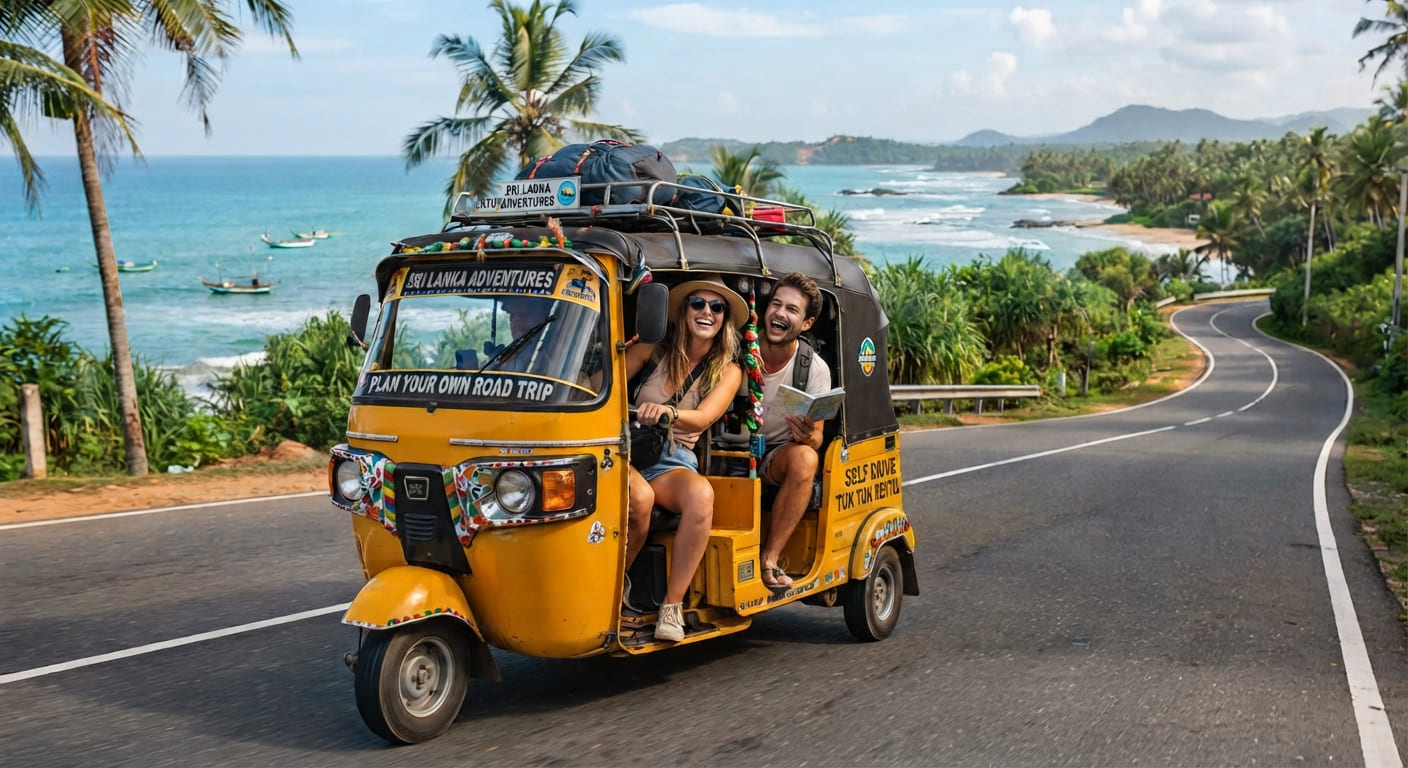
Sri Lanka is compact enough to explore over a few weeks, yet varied enough that the journey between destinations can be as memorable as the destinations themselves. A self drive tuk tuk rental in Sri Lanka gives travellers the freedom to turn those journeys into part of the holiday.
Self Drive Tuk Tuk Rental Sri Lanka: Plan Your Own Island Road Trip
Sri Lanka is compact enough to explore over a few weeks, yet varied enough that the journey between destinations can be as memorable as the destinations themselves. A self drive tuk tuk rental in Sri Lanka gives travellers the freedom to turn those journeys into part of the holiday.
Instead of moving directly from hotel to hotel, you can stop at small towns, local cafés, viewpoints, beaches, temples and roadside markets whenever something catches your attention. You also control your departure times and can adjust your route without reorganising taxis or transfers.
That freedom requires more planning than hiring a driver. Tuk tuks are slower than cars, cannot use Sri Lanka's expressways, require the correct driving authorisation, and behave differently from four-wheel vehicles.
The key is to plan a tuk tuk trip around the vehicle rather than treating it like a small rental car.
Is a Tuk Tuk the Right Vehicle for Your Sri Lanka Trip?
A tuk tuk works particularly well for travellers who want independence and have enough time to travel slowly.
It is less about getting from Colombo to another destination as quickly as possible and more about having your own transport throughout the trip.
Self drive tuk tuk rentals are especially practical if you:
- enjoy independent road trips;
- want to explore smaller towns and rural areas;
- prefer changing plans without arranging new transport;
- have a relatively flexible itinerary;
- travel with manageable luggage;
- are comfortable learning to operate an unfamiliar vehicle; and
- would rather explore gradually than cover large distances every day.
A tuk tuk may be less suitable for travellers trying to fit several distant destinations into a short holiday. Families carrying substantial luggage, people who require air conditioning, and travellers uncomfortable with busy road environments may also find a car with a driver more convenient.
The right question is not simply, "Is renting a tuk tuk fun?" It is whether the vehicle matches the pace and structure of your trip.
Build Your Route Around Time, Not Distance
One of the biggest mistakes first-time tuk tuk travellers can make is planning by kilometres alone.
A route that appears short on a map may involve town traffic, narrow roads, steep hill-country sections, rain, roadworks, railway crossings and frequent stops. You may also deliberately stop more often because you have your own vehicle.
For that reason, avoid building an itinerary in which every day depends on reaching the next destination at a precise time.
Leave room between major travel days
A better approach is to choose several bases and spend more than one night in some locations.
For example, a route might combine:
Airport or Negombo → Cultural Triangle → Kandy → Hill Country → South Coast
A longer trip could add northern or eastern Sri Lanka, depending on your interests and seasonal conditions.
Rather than adding destinations simply because they fit geographically, ask what each additional stop does to the trip. Three relaxed nights with short local drives can often be more rewarding than changing accommodation every day.
Do not plan routes through expressways
Three-wheelers are prohibited from Sri Lanka's expressway network. The Road Development Authority explicitly lists three-wheelers among vehicles that cannot enter expressways.
This matters because navigation apps may suggest an expressway as the fastest route.
Always review the route before leaving. If the recommended journey uses an expressway, select an alternative using ordinary roads.
Match Your Tuk Tuk Route to Sri Lanka's Weather
Sri Lanka does not have one simple nationwide "dry season." Weather varies significantly between regions because the island is influenced by two monsoon systems.
Sri Lanka Tourism describes the southwest monsoon as broadly affecting the southwest and hill regions from May to September, while the northeast monsoon influences the opposite part of the country later in the year. Inter-monsoon periods can also bring thunderstorms and changing conditions.
That means route planning should account for both where you are travelling and when you are travelling.
During periods when the southwest receives heavier rain, travellers may choose to spend more time around the north and east if conditions there are favourable. At other times of year, the southern and western coasts may be better suited to a coastal road trip.
Weather patterns are not guarantees. Conditions can change from year to year, and heavy rain can occur outside the typical seasonal pattern.
For a tuk tuk journey, weather matters more than it might in an enclosed car. Check forecasts regularly and avoid rigid schedules that force you to drive through poor conditions merely to reach the next booking.
What to Check Before Booking a Self Drive Tuk Tuk Rental in Sri Lanka
The daily rental rate is only one part of choosing a rental company.
Before paying a deposit, establish exactly what the rental includes.
1. Driving permit assistance
Ask the company what documentation it requires before arrival and what Sri Lankan driving authorisation it will arrange, if any.
Do not leave this discussion until vehicle collection.
2. Insurance
Confirm that the policy allows a foreign tourist to drive the vehicle and find out what happens if the tuk tuk is damaged.
Ask about:
- insurance excess or deductible;
- third-party liability;
- passenger coverage;
- theft;
- damage caused by an accident;
- exclusions; and
- situations that could invalidate coverage.
A statement that a vehicle has "insurance" is not enough information on its own.
Panda Tuk Tuk states that comprehensive insurance covering foreign drivers is included with its vehicles.
3. Roadside assistance
If you are travelling independently around the island, find out what happens if the tuk tuk stops working several hundred kilometres from the rental base.
Confirm whether support is available island-wide, how you contact the company and who pays for repairs caused by ordinary wear and tear.
4. Mileage limits
Unlimited kilometres can make route changes considerably easier.
Panda Tuk Tuk currently includes unlimited kilometres with its standard rental pricing.
5. One-way rental options
You may not want to finish your trip where you started it.
A company offering collection or delivery in multiple destinations gives you more flexibility to combine the tuk tuk with trains, hotels, flights or other transport.
6. Driving instruction
A proper handover should include enough time to become familiar with the vehicle.
Panda's current rental fleet uses manual gearboxes, and the company advertises driving lessons before departure.
Even an experienced manual-car driver should practise before entering busy traffic.
Understand the Driving Licence Requirement Before Arrival
Foreign visitors need valid driving authority for the vehicle they operate in Sri Lanka.
Sri Lanka Police reiterated in February 2026 that foreign drivers must possess an accepted valid driving document and that the authorisation must correspond to the relevant vehicle class. The police identified recognised routes including an appropriate International Driving Permit, a Sri Lankan driving permit, or an officially converted/translated foreign licence.
For a tuk tuk, the vehicle class is particularly important.
Sri Lanka Police has separately explained that a normal B-category car licence under the newer Sri Lankan classification does not itself authorise a motor tricycle; the relevant local category is B1.
Because official notices over time have described foreign-licence recognition and three-wheeler categories in different ways, travellers should not assume that holding an ordinary car licence or generic IDP automatically settles the issue.
Before travelling, confirm that the documentation being arranged specifically authorises you to drive the rented three-wheeler.
The Department of Motor Traffic also provides procedures for temporary Sri Lankan driving licences for eligible foreign visitors, with validity linked to the applicable conditions and visa period.
Keep your original driving documents with you while driving rather than depending only on digital copies.
Learn the Tuk Tuk Before Starting the Road Trip
A three-wheeler does not handle like a small car.
The narrower track, three-wheel layout, steering response, manual controls and weight distribution require adjustment. Luggage and passengers also change how the vehicle feels.
Use the rental company's training session to practise:
- starting smoothly;
- changing gears;
- braking progressively;
- turning at low speed;
- hill starts;
- reversing;
- parking;
- using indicators and lights; and
- securing the vehicle when stopped.
Do not make your first practice session the drive through a congested town.
Spend enough time near the collection point to become comfortable with the controls before beginning the first long journey.
Practical Road Habits That Make Tuk Tuk Travel Easier
Sri Lanka drives on the left-hand side of the road.
Beyond that basic rule, successful tuk tuk driving requires observation and patience.
Give buses and larger vehicles space
Avoid positioning yourself unnecessarily close to buses, lorries and other large vehicles. Maintain space in front of the tuk tuk and anticipate vehicles overtaking.
Trying to match the pace of faster road users defeats the purpose of travelling by tuk tuk.
Slow down before corners
A tuk tuk has three wheels rather than four. Cornering too quickly is therefore a poor habit, particularly with passengers or luggage.
Reduce speed before the turn instead of braking aggressively once you are already cornering.
Be cautious after dark
Visibility can vary considerably away from major urban areas. Pedestrians, bicycles, animals and roadside activity can be more difficult to see at night.
Where practical, schedule longer driving sections during daylight and aim to reach your accommodation before evening.
Stop during heavy rain
A timetable is not worth maintaining if visibility becomes poor.
Find a safe place to stop and allow intense rain to pass rather than continuing simply because accommodation has already been booked.
Fuel, Luggage and Daily Road-Trip Practicalities
A good self-drive trip depends as much on small logistical decisions as it does on the major route.
Refuel before remote stretches
Do not repeatedly run the fuel level close to empty.
Refuel when convenient, particularly before travelling into quieter rural areas or beginning a longer day's drive. Confirm the correct fuel type during vehicle handover.
Panda's current rental listings describe its Class 01 and Class 02 tuk tuks as petrol-powered vehicles.
Pack lighter than you would for a car
Large hard-shell suitcases quickly consume the usable space in a tuk tuk.
Soft bags and smaller luggage are generally easier to arrange. Keep valuables with you and avoid leaving expensive electronics visibly unattended in the vehicle.
Carry rain protection
The roof offers useful protection, but a tuk tuk is not a sealed car.
Keep passports, electronics, documents and clothing that must remain dry inside waterproof bags or covers.
Save essential information offline
Mobile coverage is useful but should not be your only contingency.
Before travelling each day, save or note:
- accommodation details;
- the rental company's support number;
- important document copies;
- destination names;
- alternative routes; and
- emergency contact information.
Offline mapping can also be valuable if your connection drops.
How Much Should You Budget for a Tuk Tuk Rental?
The daily rate usually falls as the rental period becomes longer.
As of September 2026, Panda Tuk Tuk's published rates range from approximately US$14 to US$25 per day, depending on tuk tuk class and rental duration. The company currently lists comprehensive insurance, unlimited kilometres and wear-and-tear repairs among the standard inclusions.
Your actual trip budget should include more than the base rental.
Allow for:
- fuel;
- local driving-permit processing;
- vehicle delivery or one-way return fees;
- security deposit requirements;
- optional equipment;
- parking where applicable; and
- your own travel insurance.
Current prices can change, so use published rates for initial budgeting and confirm the total applicable to your exact dates and route before booking.
A longer rental can reduce the daily vehicle cost, but that does not automatically make a longer itinerary cheaper. Extra accommodation, fuel and activities still need to be considered.
What to Do if the Tuk Tuk Develops a Problem
Mechanical problems are inconvenient, but they are easier to manage when the procedure has been agreed in advance.
Before leaving the rental location, establish:
- who you should contact first;
- whether roadside support operates throughout Sri Lanka;
- whether you are authorised to arrange minor repairs yourself;
- which repairs the rental company pays for;
- what happens if the tuk tuk cannot continue; and
- what information or photographs the company requires.
Avoid approving substantial mechanical work without contacting the rental provider unless an immediate safety issue makes that impossible.
If you are involved in an accident, prioritise personal safety and follow the rental company's accident and insurance procedure. Ensure you have access to the relevant documentation and contact details before the trip begins.
Make the Tuk Tuk Part of the Journey
The strongest reason to rent a tuk tuk is not simply that it provides transport.
It changes how you experience the route.
A trip from one major destination to another becomes an opportunity to stop at a bakery in a small town, have lunch somewhere you had never planned to visit, take a quieter road through agricultural areas, or stay longer somewhere that turns out to be more interesting than expected.
That spontaneity is difficult to reproduce when every transfer is pre-booked.
At the same time, responsible self-driving means recognising where the tuk tuk should not go. Respect road restrictions, do not attempt unsuitable tracks simply because a map displays them, and avoid disturbing wildlife or entering protected areas where private vehicles are restricted.
Freedom works best when paired with sensible judgement.
Choosing the Right Rental for Your Sri Lanka Adventure
Compare rental companies on the parts of the service that matter once you are actually on the road.
The cheapest advertised rate is less meaningful if the company cannot help with licensing, provides limited breakdown support, imposes restrictive kilometre limits or requires you to return the vehicle somewhere that does not suit your itinerary.
Look for clear information about:
- vehicle condition;
- foreign-driver insurance;
- licence assistance;
- driving instruction;
- roadside support;
- included kilometres;
- pick-up and return locations;
- deposits;
- cancellation terms; and
- responsibility for repairs.
Panda Tuk Tuk currently offers multiple collection and return locations around Sri Lanka, including the airport area, Colombo, Kandy, Sigiriya/Dambulla, Ella, Galle, Mirissa, Trincomalee, Arugam Bay, Anuradhapura and Jaffna, with location-dependent delivery charges.
That type of flexibility can be particularly useful for travellers who want to create a one-way route rather than drive a complete loop.
A self drive tuk tuk rental in Sri Lanka works best when the trip is designed around freedom rather than speed.
Choose a manageable route, account for regional weather, confirm that your driving documentation covers a three-wheeler, learn the vehicle properly and avoid planning every day to its maximum possible distance.
The result is a different style of Sri Lankan holiday: less focused on transfers and more focused on what happens between destinations.
If that is how you want to travel, compare Panda Tuk Tuk's current rental options, pick-up locations and rental durations, then build an itinerary with enough flexibility to enjoy the road instead of rushing through it.