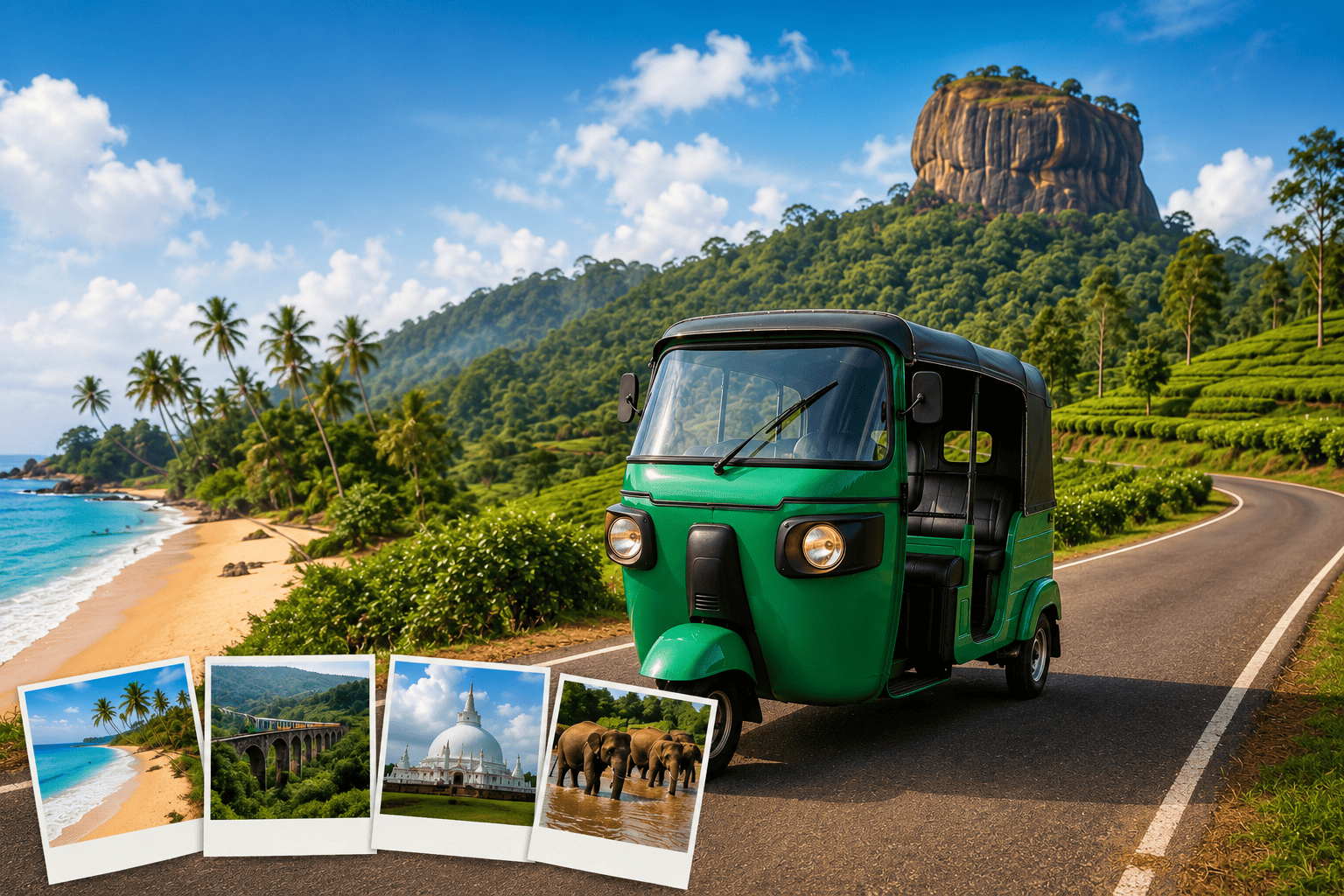
Few travel experiences match the raw thrill of navigating open coastal roads, winding mountain passes, and lush tea plantations behind the handlebars of an iconic three-wheeler.
Self Drive Tuk Tuk Rental: The Ultimate Guide to Exploring Sri Lanka on Three Wheels
Few travel experiences match the raw thrill of navigating open coastal roads, winding mountain passes, and lush tea plantations behind the handlebars of an iconic three-wheeler. Choosing a self drive tuk tuk rental in Sri Lanka transforms a standard vacation into an immersive, flexible overland expedition.
Instead of watching stunning landscapes glide past a tour bus window or negotiating taxi fares at every stop, driving your own vehicle gives you total autonomy over your itinerary. Whether you want to pause for fresh king coconuts on a quiet southern beach or detour down a misty mountain track in the central highlands, self-driving puts you in complete control.
This comprehensive guide covers everything you need to know about organizing a tuk tuk rental in Sri Lanka—from legal driving permits and insurance essentials to route planning, mechanical basics, and road safety.
Why Choose a Self Drive Tuk Tuk Rental in Sri Lanka?
Renting and driving a tuk tuk has quickly become one of the most rewarding ways to experience the island. Here is why independent travellers are choosing three wheels over traditional transport options:
- Unmatched Itinerary Freedom: Set your own schedule, stop at hidden viewpoints, and alter your route whenever serendipity strikes.
- Authentic Cultural Immersion: Driving an auto-rickshaw breaks down social barriers. Locals frequently greet self-driving travellers with warm smiles, helpful directions, and genuine hospitality.
- Cost Efficiency: Splitting rental, fuel, and maintenance costs across two or three passengers makes it significantly cheaper than hiring a private driver for weeks.
- Compact Maneuverability: Tuk tuks excel at navigating narrow rural lanes, crowded village markets, and tight coastal tracks where large SUVs cannot easily go.
Essential Legal Requirements & Driving Permits
You cannot legally drive a three-wheeler in Sri Lanka with only a standard domestic driving license or a raw International Driving Permit (IDP). Sri Lankan traffic law mandates a local endorsement before you take the wheel.
┌────────────────────────────────────────────────────────┐
│ LEGAL PERMIT CHECKLIST │
├────────────────────────────────────────────────────────┤
│ 1. Valid Home Country Driving License │
│ 2. International Driving Permit (1949 or 1968 Conv.) │
│ 3. AAC Recognition Permit OR Sri Lankan Temp. License │
│ 4. Comprehensive Commercial Rental Insurance Policy │
└────────────────────────────────────────────────────────┘
1. The Automobile Association of Ceylon (AAC) Endorsement
If you hold a valid national driving license alongside an International Driving Permit (IDP), the Automobile Association of Ceylon (AAC) can issue a local endorsement. This verification confirms that your home country permits you to operate light motor vehicles. Reputable rental platforms, such as Panda Tuk Tuk, typically handle this paperwork in advance so your verified permit is ready upon arrival.
2. Department of Motor Traffic (DMT) Temporary Driving License
If you do not possess an IDP, you must obtain a temporary driving license directly from the Department of Motor Traffic in Werahera, Colombo. You will need:
- Your original passport and valid tourist visa.
- Your valid national driving license with English translation (if applicable).
- Official government processing fees.
3. Comprehensive Commercial Insurance
Standard personal travel insurance policies frequently exclude three-wheeled motorized vehicles. Ensure your tuk tuk rental Sri Lanka provider supplies comprehensive commercial rental insurance that covers third-party liabilities, vehicle damage, and passenger injuries.
Step-by-Step: How to Rent a Tuk Tuk in Sri Lanka
Securing a reliable three-wheeler requires careful vetting to guarantee safety, mechanical integrity, and legal compliance.
[ Step 1: Pre-Booking ]
│
▼
[ Step 2: License Processing ]
│
▼
[ Step 3: Vehicle Inspection ]
│
▼
[ Step 4: Practical Driving Lesson ]
│
▼
[ Step 5: Road Adventure Begins ]
Step 1: Reserve in Advance Online
Reserve your vehicle several weeks ahead, particularly during peak travel windows (December to April and July to August). Booking early allows your rental operator sufficient time to process your AAC permit endorsements.
Step 2: Complete the Pre-Drive Inspection
Before signing the rental contract, conduct a detailed physical inspection alongside the rental agent:
- Braking System: Test the foot brake pedal tension and check handbrake engagement on an incline.
- Tire Condition: Check tread depth on all three tires plus the mandatory spare wheel.
- Electronics: Confirm headlights, high beams, indicators, brake lights, horn, and cabin lights operate correctly.
- Bodywork & Weather Curtains: Document existing scratches or dents on camera and ensure waterproof side curtains roll down and buckle securely.
Step 3: Take a Hands-On Driving Lesson
Reputable operators require every driver to complete a practical training session regardless of prior manual driving experience. A professional instructor will teach you the mechanics of the sequential handlebar gear shift, clutch control, braking distance, and turning balance.
Technical Comparison: Selecting Your Rental Vehicle
Most three-wheelers in Sri Lanka are manufactured by Bajaj Auto. Understanding the vehicle specifications helps you plan realistic daily driving distances and fuel budgets.
|
Specification / Feature |
Bajaj RE 4-Stroke (Petrol) |
Bajaj Maxima / Diesel Variant |
|
Engine Capacity |
~198 cc – 215 cc |
~470 cc |
|
Transmission |
4-Speed Manual (Handlebar Shift) |
4-Speed Manual + Reverse |
|
Fuel Efficiency |
25 – 32 km / Liter |
30 – 38 km / Liter |
|
Top Cruising Speed |
40 km/h (Legal Limit) |
40 km/h (Legal Limit) |
|
Climbing Ability |
Moderate (Requires gear management) |
High Torque (Ideal for steep hills) |
|
Luggage Capacity |
2 Backpacks + 1 Daypack |
2 Large Suitcases + Backpacks |
|
Best Suited For |
Coastal Cruising & Cultural Triangle |
Long-distance Highland Expeditions |
Mastering the Three-Wheeler: Crucial Driving & Handling Tips
Operating a tuk tuk differs significantly from driving a standard car or riding a two-wheeled motorcycle. Keep these handling fundamentals in mind:
1. Respect the Center of Gravity
Because a tuk tuk rests on a single front steering wheel, taking sharp turns at high speed creates a rollover hazard. Always decelerate smoothly before initiating a turn, downshift to second or first gear, and accelerate gently as you exit the corner.
2. Manage the Sequential Handlebar Transmission
The clutch lever sits on the left handlebar, integrated with a twist-grip gear selector. Avoid riding the clutch pedal or forcing gears into place without full clutch disengagement. If the gearbox feels stiff at a standstill, gently rock the vehicle backward an inch to align the transmission cogs.
3. Brake Early with the Foot Pedal
Unlike a motorcycle where hand levers control braking, a tuk tuk uses a right-foot pedal linked to all three drum brakes. Drum brakes require greater stopping distance, especially when descending steep mountain slopes or driving in heavy tropical downpours.
Top Self-Drive Itineraries Across Sri Lanka
A self drive tuk tuk rental opens up diverse regional landscapes across the island. Here are three tested routes tailored for three-wheeled exploration:
Route A: Southern Coastline ──► Colombo ➔ Galle ➔ Mirissa ➔ Hiriketiya
Route B: Cultural Triangle ──► Negombo ➔ Sigiriya ➔ Dambulla ➔ Polonnaruwa
Route C: Central Highlands ──► Kandy ➔ Nuwara Eliya ➔ Ella ➔ Wellawaya
Route 1: The Southern Coastal Cruise (7–10 Days)
- Route: Negombo / Colombo $\rightarrow$ Bentota $\rightarrow$ Galle Fort $\rightarrow$ Weligama $\rightarrow$ Hiriketiya $\rightarrow$ Tangalle
- Terrain: Flat, paved coastal roads (A2 Highway).
- Highlights: World-class surf breaks, colonial Dutch fortifications, fresh seafood markets, and tranquil beach coves.
- Driving Difficulty: Beginner-friendly.
Route 2: The Cultural Triangle & Wildlife Plains (8–12 Days)
- Route: Negombo $\rightarrow$ Kurunegala $\rightarrow$ Dambulla $\rightarrow$ Sigiriya $\rightarrow$ Habarana $\rightarrow$ Minneriya
- Terrain: Wide, well-paved inland trunk roads with minimal gradient.
- Highlights: Ancient rock fortresses, cave temples, and opportunities to spot wild elephants from safe roadside distances along forest corridors.
- Driving Difficulty: Moderate (watch for wild elephant crossings near Habarana).
Route 3: The Highland Tea Trail (10–14 Days)
- Route: Kandy $\rightarrow$ Gampola $\rightarrow$ Nuwara Eliya $\rightarrow$ Haputale $\rightarrow$ Ella
- Terrain: Steep mountain ascents, sharp hairpin turns, and frequent mist/rain.
- Highlights: Expansive tea estates, cascading waterfalls, and panoramic mountain passes.
- Driving Difficulty: Advanced (requires active engine braking and confident hill-start techniques).
Road Safety, Etiquette, and Local Traffic Laws
Driving in South Asia demands heightened situational awareness, defensive habits, and an understanding of unwritten local driving customs.
Understanding the Highway Hierarchy
Sri Lankan road dynamics operate on an informal size-based hierarchy:
- Private and Public Buses: Always yield right-of-way immediately. Buses travel rapidly and frequently overtake across center lines.
- Heavy Trucks and Construction Lorries: Maintain wide following distances to avoid blind spots.
- Vans, SUVs, and Passenger Cars: Expect them to overtake your tuk tuk on narrow roads.
- Tuk Tuks, Scooters, and Pedestrians: Keep to the left margin of your lane to allow faster traffic to pass smoothly.
▲ [ LARGEST: Heavy Buses & Commercial Trucks ] ── Highest Priority
╱ ╲
╱ ╲ [ MID-SIZE: Commercial Vans, SUVs, & Cars ]
╱ ╲
╱───────╲ [ COMPACT: Tuk Tuks, Scooters, & Cyclists ] ── Keep Left
Key Traffic Regulations
- Speed Limits: The statutory speed limit for three-wheelers across Sri Lanka is strictly 40 km/h, even on open intercity highways where cars travel at 70 km/h.
- Expressway Ban: Tuk tuks are strictly prohibited from entering Sri Lankan expressways (such as the E01 Southern Expressway and E02 Outer Circular Highway). Use standard national routes (A and B designated roads).
- Alcohol Tolerance: Sri Lanka enforces a zero-tolerance policy regarding driving under the influence of alcohol or drugs.
- Fuel Station Etiquette: Tuk tuks run on 92 Octane petrol. Pull up to the two-wheeler/three-wheeler fuel queue at Ceypetco or LIOC stations.
Essential Packing List & Breakdown Kit
When undertaking an overland trip by three-wheeler, keep your gear organized and protected against tropical elements:
- Luggage Strategy: Soft duffle bags or medium backpacks pack much easier into a tuk tuk's rear storage compartment than rigid, hard-shell suitcases.
- Waterproof Dry Bags: Protect electronic gear, cameras, and passports from sudden tropical downpours.
- Navigation Setup: A sturdy smartphone handlebar mount, offline maps (Maps.me or downloaded Google Maps), and a 12V USB charging adapter or high-capacity power bank.
- Emergency Kit Checklist:
- Complete spare tire with adequate air pressure
- Working scissor jack and wheel-nut wrench
- Spare spark plug and plug spanner
- Spare throttle/clutch inner cables
- Basic first-aid supplies and high-visibility safety triangle
Start Your Three-Wheeled Expedition
A self drive tuk tuk rental offers an unfiltered, deeply memorable way to explore Sri Lanka's coastlines, historic sites, and misty mountain ranges. Navigating the island at a steady 40 km/h brings you closer to the landscape and the people who call it home.
When you are ready to organize your adventure, partner with verified rental specialists like Panda Tuk Tuk to secure roadworthy vehicles, comprehensive insurance, official driving permit processing, and comprehensive driving instruction before you set off. Verify your documentation, inspect your vehicle, and set out to experience Sri Lanka on your own terms.