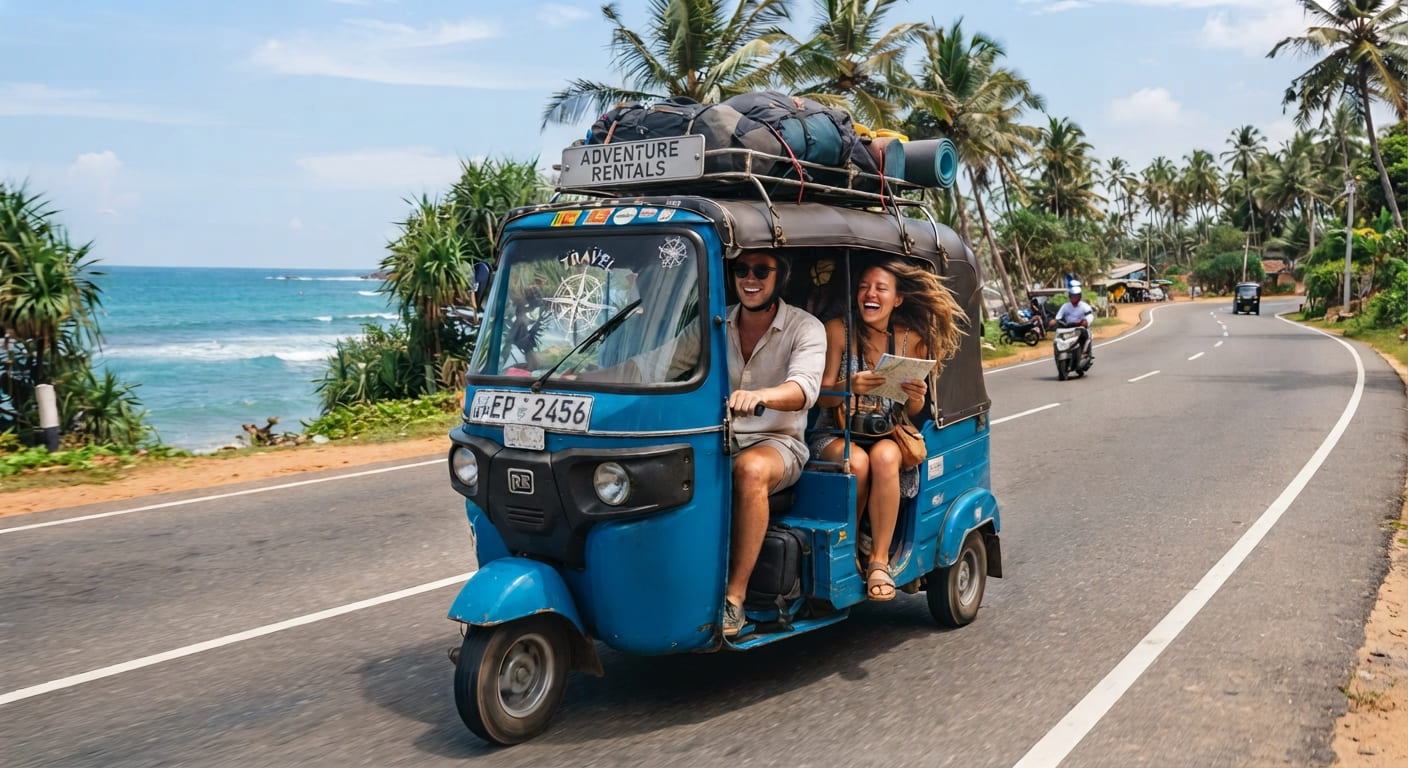
A tuk tuk gives you a very different way to travel around Sri Lanka. Instead of planning every journey around buses, trains, taxis, or a private driver, you can stop at a roadside fruit stall, take a detour through a village, spend longer at a beach, or change your route without reorganising your transport.
Self Drive Tuk Tuk Rental in Sri Lanka: What Travellers Need to Know
A tuk tuk gives you a very different way to travel around Sri Lanka. Instead of planning every journey around buses, trains, taxis, or a private driver, you can stop at a roadside fruit stall, take a detour through a village, spend longer at a beach, or change your route without reorganising your transport.
A self drive tuk tuk rental in Sri Lanka can therefore work particularly well for travellers who value flexibility and are comfortable travelling at a slower pace. But renting one is not simply a matter of collecting the keys. Foreign-driver permits, insurance, three-wheeler driving techniques, road restrictions, vehicle condition, and realistic travel times all need attention before you set off.
This guide explains how self drive tuk tuk rentals work, what documents to arrange, what costs to consider, and how to decide whether a tuk tuk is the right vehicle for your Sri Lanka trip.
Why Rent a Tuk Tuk and Drive Yourself Around Sri Lanka?
The main advantage is independence.
Sri Lanka's best-known destinations are connected by public transport, but many interesting places sit between those destinations: small temples, viewpoints, quiet beaches, village restaurants, roadside markets, waterfalls, tea-growing areas, and rural roads that are difficult to incorporate into a fixed transport schedule.
With your own tuk tuk, those stops become much easier.
A self-drive rental can also suit travellers taking a multi-week trip. Instead of repeatedly arranging taxis and transfers, the vehicle stays with you as you move from one area to another.
There are compromises, however. A tuk tuk is slower, less weatherproof, noisier, and physically more demanding than travelling in an air-conditioned car. Sri Lanka's Road Development Authority also prohibits three-wheelers from using the country's expressways, so tuk tuk journeys must use the ordinary road network.
For many travellers, that slower style is part of the appeal. For others, particularly those with a short itinerary and several long-distance transfers, a car and driver may be more practical.
How Self Drive Tuk Tuk Rental Sri Lanka Trips Work
The exact process varies between rental companies, but a well-organised rental normally involves five stages:
- Choose your rental dates and locations. Decide where you want to collect and return the tuk tuk. One-way arrangements can be particularly useful if your itinerary does not form a loop.
- Provide your driving documents in advance. Depending on the permit route being used, this may include your home driving licence and International Driving Permit.
- Arrange the required Sri Lankan driving documentation. Do this before driving rather than assuming your foreign licence automatically covers a three-wheeler.
- Complete a vehicle handover and driving lesson. Learn the clutch, gears, braking characteristics, starting procedure, parking technique, and controls before entering traffic.
- Inspect the tuk tuk and confirm support procedures. Know whom to contact for a breakdown, accident, tyre problem, or mechanical fault.
Panda Tuk Tuk currently states that its rentals include a driving lesson, comprehensive insurance, unlimited kilometres, and roadside support, with pick-up and drop-off available at numerous locations around Sri Lanka. Its listed vehicles use manual gearboxes.
Even if you already drive a manual car, do not skip the tuk tuk lesson. The control layout, balance, braking and cornering behaviour are different from a conventional four-wheel vehicle.
Driving Licence and Permit Requirements for Foreign Travellers
This is the part of a Sri Lankan tuk tuk rental that should be resolved before you travel.
Current guidance concerning foreign driving permits is not described identically by every authority and travel advisory. Sri Lanka Police stated in February 2026 that foreign drivers must possess an appropriate valid driving document covering the relevant vehicle class, identifying routes including an International Driving Permit, a Sri Lankan driving permit for foreign residents, or an official Department of Motor Traffic translation of a foreign licence. The police also emphasised that rental businesses must verify that foreign customers are properly licensed.
The Department of Motor Traffic separately provides a procedure for issuing temporary Sri Lankan driving licences to foreign visitors, subject to the applicable conditions and visa period.
International travel guidance can be more restrictive. Current UK government advice, for example, tells British travellers to obtain a 1949 International Driving Permit and a Sri Lankan Recognition Permit from the Automobile Association of Ceylon.
The vehicle class matters
A particularly important issue for tuk tuk renters is that a tuk tuk is a three-wheeler. Do not assume documentation valid for an ordinary car automatically authorises you to drive one.
Panda Tuk Tuk states that it arranges a Sri Lankan Recognition Permit for customers and advises that a standalone IDP is not sufficient for its foreign customers driving three-wheelers.
Because procedures and interpretations have changed over time, the practical approach is to confirm before departure that:
- your home licence and IDP meet the current requirements;
- the Sri Lankan document being arranged is valid for the tuk tuk you will drive;
- the relevant three-wheeler vehicle class is covered; and
- your insurance remains valid under that licensing arrangement.
Bring the original driving documents requested by the rental provider rather than relying solely on photographs stored on your phone.
What Does a Tuk Tuk Rental in Sri Lanka Cost?
Rental cost depends primarily on the length of your booking, vehicle class, pick-up and return locations, licensing arrangements, optional equipment, and fuel.
At the time this article was reviewed, Panda Tuk Tuk's published daily rental table showed rates ranging from US$14 to US$25 per day, depending on the vehicle class and length of rental. Longer bookings receive lower daily rates. The company states that comprehensive insurance and unlimited kilometres are included in its standard rental rates.
Treat published figures as a planning reference rather than a permanent price. Rental rates, permit-processing charges, deposits, optional equipment and delivery fees can change, so check the final booking total for your actual dates.
Costs to consider beyond the daily rate
Fuel should be budgeted separately, along with any charge for delivering or collecting the tuk tuk outside the operator's standard location.
If you are comparing self drive tuk tuk rentals purely by headline price, also check what is included. A cheaper daily rate can become less attractive if insurance, licence assistance, roadside help, kilometre limits, or vehicle delivery are charged separately.
More importantly, understand any insurance excess and exclusions. "Comprehensive insurance" does not necessarily mean every type of damage is covered without conditions. Ask what happens following an accident, what the driver's financial liability is, and whether insurance can be affected by an invalid licence, an unauthorised driver, reckless use, or other policy exclusions.
What to Check Before Accepting Your Tuk Tuk
Spend time inspecting the vehicle at handover. This is not merely about avoiding a dispute over scratches.
Check the tyres, brakes, headlights, indicators, horn, mirrors and windscreen wiper. Confirm that the spare wheel and basic equipment supplied with the vehicle are present. Sri Lankan regulations governing motor tricycles contain specific requirements concerning equipment including mirrors, lights, a functioning windscreen wiper, speedometer and spare tyre arrangements.
Take clear photographs or video of the tuk tuk before departure, including existing body damage.
You should also understand how to check the engine oil if required, where to refuel, what fuel the vehicle takes, how to secure luggage, how the parking brake works, and what warning signs indicate a mechanical problem.
Finally, save the rental company's emergency number somewhere accessible offline.
Driving a Tuk Tuk Safely on Sri Lankan Roads
Sri Lanka drives on the left-hand side. Travellers from countries that drive on the right should allow additional time to adjust, especially at intersections and roundabouts.
The more significant adjustment, however, is often local traffic behaviour.
Buses, motorcycles, cars, bicycles, pedestrians, dogs and tuk tuks may all occupy the same road environment. Overtaking can happen frequently, and conditions can change quickly around towns and villages. Current UK travel advice warns that road travel can be hazardous, that some roads are in poor condition, and that accidents are particularly concerning at night.
A few habits make self-driving more manageable.
Leave more stopping distance than you would in a car, slow down before bends, and avoid sudden steering inputs. A three-wheeled vehicle does not corner like a four-wheeled one.
Be particularly cautious around buses and heavy vehicles. Do not assume another driver has seen you simply because you are visible in your own mirrors.
Avoid planning long driving days after dark. Apart from reduced visibility, you may encounter pedestrians, animals, bicycles and vehicles with limited lighting.
In hill country around places such as Kandy, Nuwara Eliya and Ella, allow additional time for steep gradients and twisting roads. Heavy luggage and passengers can also affect acceleration and braking.
And remember that tuk tuks cannot use Sri Lanka's expressways. Route-planning apps may suggest roads that are unsuitable for your vehicle, so inspect the proposed route rather than blindly following the fastest option.
How Far Should You Drive Each Day?
One of the most common planning mistakes is treating tuk tuk travel times like car travel times.
Distances that look short on a map can involve towns, mountain roads, heavy traffic, construction, frequent junctions, rain, or scenic stops. A 150-kilometre travel day in a tuk tuk is not equivalent to a 150-kilometre motorway journey in Europe, Australia, or North America.
Build your itinerary around comfortable travel days rather than maximum distance.
For example, a traveller might combine the Cultural Triangle around Sigiriya and Dambulla with Kandy, then move gradually into the hill country before heading toward the southern or eastern coast. Travellers with more time can extend north toward Anuradhapura or Jaffna, or east toward Trincomalee and Arugam Bay.
Panda Tuk Tuk currently lists rental pick-up or drop-off availability across destinations including the airport area, Colombo, Kandy, Sigiriya/Dambulla, Ella, Nuwara Eliya, Galle, Mirissa, Arugam Bay, Trincomalee, Anuradhapura and Jaffna, making non-circular itineraries possible subject to availability and delivery charges.
Is a Self-Drive Tuk Tuk Better Than a Car, Train or Private Driver?
There is no single best transport option for every Sri Lanka itinerary.
A tuk tuk is strongest when independence and flexibility matter more than speed and comfort. It allows you to explore independently while keeping the vehicle with you between destinations.
A rental car provides better weather protection, luggage security and long-distance comfort, but is larger and can be more stressful on narrow or congested roads.
A private driver removes most of the workload associated with navigation, parking and traffic. It is often a sensible choice for families, travellers with limited time, or anyone uncomfortable driving abroad.
Trains are valuable for selected routes and can be part of the experience rather than simply transportation. They do not, however, provide door-to-door flexibility.
You also do not necessarily have to choose one method for the entire holiday. Panda, for example, advertises a service designed to move a rental tuk tuk between selected hill-country locations while customers travel part of the journey by train.
Who Is a Self Drive Tuk Tuk Rental Best For?
A tuk tuk tends to suit travellers spending enough time in Sri Lanka to enjoy the journey rather than rushing between attractions.
It is particularly appealing to couples, friends and independent travellers who enjoy road trips, spontaneous stops and flexible itineraries.
It is less suitable if your schedule requires covering large distances quickly, if you strongly prefer air-conditioned transport, or if you are uncomfortable dealing with unfamiliar traffic.
You should also think realistically about luggage. Even when a vehicle technically has enough passenger capacity, several large suitcases can make a small three-wheeler inconvenient. Travel lighter where possible and make sure luggage is securely positioned.
Choosing a Reliable Tuk Tuk Rental Company
Price matters, but it should not be the only comparison point.
Look for a rental company that clearly explains the driving-permit process, insurance coverage, vehicle handover, breakdown procedure, maintenance responsibility and deposit conditions.
Roadside assistance is particularly important on a multi-day self-drive trip. Even a well-maintained tuk tuk can develop a puncture or mechanical issue hundreds of kilometres from the original collection point.
The company should also give you enough instruction to become comfortable with the vehicle rather than handing it over after a brief explanation.
For a long rental, island-wide support and flexible return locations can be more valuable than saving a few dollars on the initial daily price.
Plan the Road Trip Before You Book the Vehicle
A successful Sri Lankan tuk tuk trip starts with an itinerary that respects the vehicle.
Choose fewer bases and give yourself time between them. Avoid scheduling a major attraction and a long cross-country drive on the same day. Keep some flexibility for weather, road conditions and places you discover along the way.
Before confirming the booking, check your licence documents, verify the applicable three-wheeler permit, understand your insurance, review the rental terms and decide where you want to collect and return the vehicle.
That preparation leaves you free to enjoy the main reason people choose a tuk tuk in the first place: travelling through Sri Lanka at road level, on your own schedule.
Conclusion
A self drive tuk tuk rental in Sri Lanka can turn transportation into part of the trip itself. The strongest reasons to choose one are freedom, route flexibility and access to places that are awkward to visit on a fixed transport schedule.
The experience works best when you approach it as a slow road trip rather than a substitute for a fast rental car. Arrange the correct driving documentation, confirm the three-wheeler category, understand your insurance, inspect the vehicle carefully and plan conservative daily distances.
Travellers considering Panda Tuk Tuk can compare the available vehicle classes, rental duration, pick-up and drop-off locations, permit assistance and included support before choosing the option that fits their route.