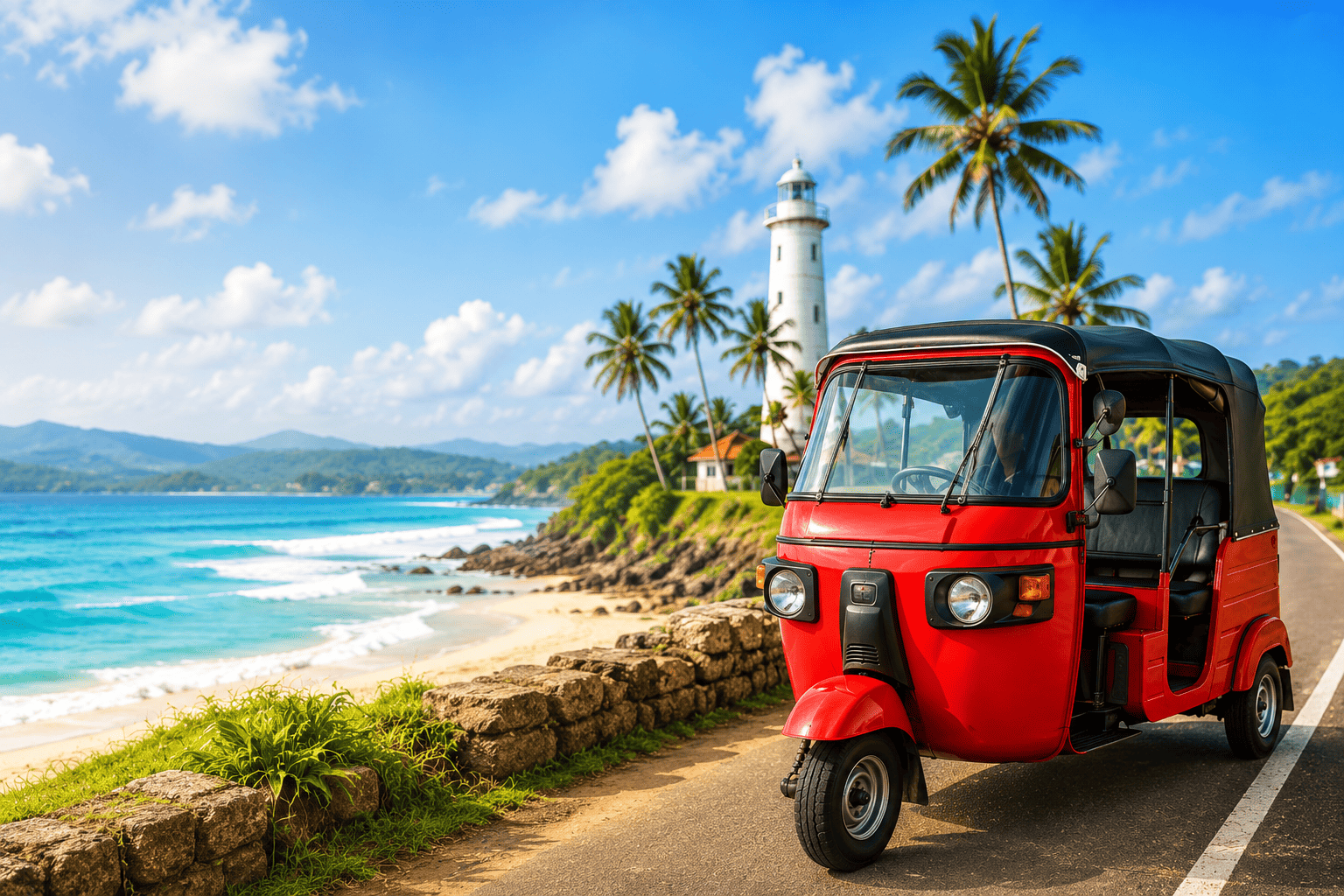
Steering an open-sided three-wheeler past sun-drenched palm groves and hillside villages is one of the purest ways to connect with Sri Lanka
Self Drive Tuk Tuk Rental: How to Experience Sri Lanka on Your Own Terms
Steering an open-sided three-wheeler past sun-drenched palm groves and hillside villages is one of the purest ways to connect with Sri Lanka. Choosing a self drive tuk tuk rental breaks you out of the standard tourist bubble, turning transport into the highlight of your journey.
Rather than sticking to rigid train schedules or crowded tour coaches, driving yourself gives you the freedom to pull over for a roadside roti whenever you choose. You dictate the pace, whether that means staying an extra day in a sleepy fishing hamlet or heading inland toward hidden highland waterfalls.
This comprehensive guide breaks down everything you need to know about setting up a tuk tuk rental in Sri Lanka—covering licensing protocols, day-to-day driving tactics, fuel management, and unforgettable road-trip circuits.
Why Independent Travelers Are Choosing Three Wheels
Renting a personal vehicle has become the gold standard for travelers seeking authentic cultural encounters and genuine overland adventure. When you drive an auto-rickshaw across the island, several distinct benefits immediately stand out:
- Spontaneous Detours: The freedom to turn down unmarked country lanes, uncover secluded beaches, and explore rural temples without negotiating fares or sticking to fixed itineraries.
- Warm Local Connections: Traveling in a local vehicle creates an immediate rapport with communities. Residents along your route will offer waves, roadside navigation help, and welcoming hospitality.
- Low Running Costs: Sharing vehicle rental, 92-octane fuel, and parking fees between travel companions keeps travel expenses low compared to hiring a private driver for several weeks.
- Effortless Parking: The small footprint of an auto-rickshaw allows you to maneuver through narrow village streets and park in compact spaces where regular vehicles cannot fit.
Legal Requirements and Documentation Essentials
Driving legally in Sri Lanka requires specific documentation before you take the wheel. Operating a three-wheeler on a foreign national license alone is against traffic law and can void your insurance coverage.
┌────────────────────────────────────────────────────────┐
│ DOCUMENTATION VERIFICATION │
├────────────────────────────────────────────────────────┤
│ 1. National Driver’s License (Home Country) │
│ 2. International Driving Permit (1949/1968) │
│ 3. AAC Endorsement or DMT Temporary Driving Permit │
│ 4. Comprehensive Commercial Rental Insurance Cover │
└────────────────────────────────────────────────────────┘
Automobile Association of Ceylon (AAC) Recognition
If you hold a valid national driving license alongside an International Driving Permit (IDP), the Automobile Association of Ceylon (AAC) can issue an official local endorsement. This verification confirms that your home country permits you to operate light motor vehicles. Reputable rental platforms, such as Panda Tuk Tuk, handle this entire verification process ahead of time so your legal paperwork is ready when you land.
Department of Motor Traffic (DMT) Temporary Permit
If you do not have an IDP, you must apply in person for a temporary driving permit at the Department of Motor Traffic in Werahera, Colombo. This route requires your physical passport, a copy of your valid tourist visa, your national driving license with a certified English translation, and the required government administrative fees.
Commercial Insurance Protection
Personal travel insurance policies frequently exclude three-wheeled motorized vehicles. Ensure your tuk tuk rental Sri Lanka company supplies comprehensive commercial rental insurance that covers third-party damage, vehicle repairs, and passenger protection across the entire island.
Step-by-Step: How to Rent a Tuk Tuk in Sri Lanka
Securing a reliable three-wheeler requires careful vetting to guarantee safety, mechanical performance, and complete legal compliance before departure.
[ Step 1: Online Booking & Document Submission ]
│
▼
[ Step 2: Comprehensive Vehicle Inspection ]
│
▼
[ Step 3: Practical Driving Instruction ]
│
▼
[ Step 4: Route Orientation & Launch ]
1. Pre-Book Online and Submit Paperwork Early
Book your rental several weeks in advance, especially during the busy winter and summer holiday seasons. Submitting your driving credentials early gives your rental provider plenty of time to clear your endorsement through local authorities before you arrive.
2. Perform a Thorough Mechanical Check
Before accepting your vehicle, inspect every key component alongside your rental representative:
- Check brake pedal firmness and confirm the mechanical handbrake holds firmly on an incline.
- Inspect the condition and tread depth of all three tires, as well as the spare wheel mounted under the frame.
- Test headlights, turn signals, horn, hazard lights, and cabin switches to verify all electrical wiring is working.
- Confirm that waterproof storm curtains unroll easily and fasten securely along the frame sides to keep rain out.
3. Complete a Practical Driving Lesson
A trustworthy rental provider will always require a comprehensive hands-on training session before handing over the keys. An instructor will guide you through starting the engine, feathering the clutch, shifting gears via the handlebar grip, making tight turns, and mastering emergency stops.
Mechanical Basics and Daily Operation
Most three-wheelers in Sri Lanka are powered by single-cylinder, four-stroke engines engineered for simplicity and durability. Getting comfortable with a few mechanical habits makes daily driving smooth and reliable:
- Engine and Transmission: Tuk tuks typically feature a four-speed manual transmission integrated into the left handlebar grip, paired with a reverse lever beside the driver's seat.
- Braking Setup: All three drum brakes are operated via a single right-foot pedal. Always begin braking early, as drum brakes require steady pressure and greater stopping distance than disc brakes.
- Fuel Efficiency: Expect an average range of 25 to 32 kilometers per liter of 92-octane petrol. With a standard 7 to 8-liter tank, you can comfortably cover 180 to 220 kilometers between fuel stops.
- Cruising Speed: While vehicles can reach higher speeds on open roads, the legal nationwide speed limit for three-wheelers is strictly 40 km/h. Maintaining this speed ensures stability and keeps fuel consumption low.
Defensive Driving Tactics for Sri Lankan Roads
Navigating Sri Lankan traffic is an engaging experience that requires patience, continuous observation, and an understanding of local road habits.
[ Heavy Buses & Trucks ] ──► Has Right-of-Way / Demands Wide Berth
[ SUVs & Passenger Cars ] ──► Fast-Moving / Frequent Overtakers
[ Tuk Tuks & Scooters ] ──► Cruise on the Left Side of the Lane
1. The Right-of-Way Rule of Thumb
Traffic in Sri Lanka follows a practical, size-based hierarchy. Heavy long-distance buses and commercial lorries take absolute priority on every road type. When you spot a large bus approaching or overtaking in your lane, calmly indicate, slow down, and steer toward the left shoulder to let them pass.
2. Cornering and Weight Distribution
Because three-wheelers balance on a single front tire, high-speed cornering creates instability. Always brake in a straight line before entering a bend, downshift into second gear, and accelerate gently only after the vehicle levels out. Keep heavy luggage placed low in the rear storage bay to maintain a stable center of gravity.
3. Managing Expressways and Route Restrictions
Three-wheelers are legally barred from all high-speed national expressways, including the Southern Expressway (E01) and Central Expressway (E04). Plan your navigation through primary "A" and secondary "B" roads, which provide paved tarmac, scenic views, and convenient roadside stops.
Three Scenic Self-Drive Itineraries
A self drive tuk tuk rental lets you discover distinct geographical regions at your own pace. Here are three proven driving routes:
Circuit 1: Southern Beaches ──► Negombo ➔ Bentota ➔ Galle ➔ Hiriketiya
Circuit 2: Ancient Ruins ──► Colombo ➔ Kurunegala ➔ Sigiriya ➔ Polonnaruwa
Circuit 3: Highland Valleys ──► Kandy ➔ Nuwara Eliya ➔ Ella ➔ Wellawaya
The Southern Coastal Circuit (5 to 7 Days)
- Route: Negombo to Galle Fort, Weligama, and Hiriketiya Bay.
- Road Conditions: Flat, well-paved coastal roads along the scenic A2 highway.
- Key Attractions: Dutch colonial ramparts, quiet surf breaks, and fresh seafood stalls.
- Driving Level: Ideal for beginners building their confidence behind the wheel.
The Cultural Triangle Expedition (7 to 10 Days)
- Route: Negombo through Kurunegala, Dambulla, Sigiriya, and Habarana.
- Road Conditions: Wide inland corridors with gentle terrain and light traffic outside market towns.
- Key Attractions: Ancient fortress rocks, cave monasteries, and wildlife viewing corridors.
- Driving Level: Moderate; stay alert for wild elephant warning signs along forest reserves.
The Central Tea Country Loop (8 to 12 Days)
- Route: Kandy climbing toward Nuwara Eliya, Haputale, Ella, and Wellawaya.
- Road Conditions: Mountainous switchbacks, steep gradients, and frequent afternoon mist.
- Key Attractions: Rolling tea plantations, mountain passes, and cascading waterfalls.
- Driving Level: Advanced; requires good gear control and confident hill-start technique.
Packing Essentials and Roadside Preparedness
Packing smart makes life on the road far more comfortable when traveling by auto-rickshaw:
- Soft-Sided Luggage: Duffel bags and soft backpacks fit much more easily into the rear luggage bay than hard-shell suitcases.
- Weatherproof Protection: Store sensitive electronics, cameras, and travel documents inside sealed dry bags to protect them from sudden rain showers.
- Navigation Tools: Bring a reliable smartphone handlebar mount, a portable USB power bank, and pre-downloaded offline maps to navigate areas with weak mobile reception.
- Essential Roadside Gear: Confirm your rental vehicle includes a functional scissor jack, wheel-nut wrench, calibrated spare tire, replacement spark plug, spare cables, and a basic emergency first-aid kit.
Plan Your Three-Wheeled Journey
A self drive tuk tuk rental transforms an ordinary vacation into an authentic road trip adventure across Sri Lanka's coasts, historic landmarks, and mountain ranges. Traveling at an easy 40 km/h allows you to take in the landscapes, chat with locals, and explore areas well off the tourist trail.
When you are ready to hit the road, team up with trusted specialists like Panda Tuk Tuk to take care of driving permit processing, comprehensive commercial insurance, vehicle handovers, and full driving instruction before you start your engine. Prepare your documents, pack your bags, and set off on your own Sri Lankan journey.